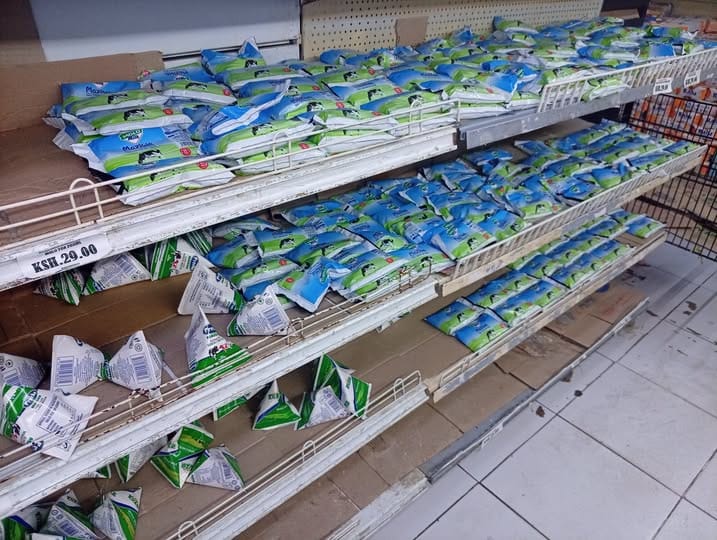
Kenya’s current milk shortage should be treated as a warning about weaknesses in the dairy supply chain, rather than simply a temporary problem of having too little milk.
The situation is particularly troubling because Kenya is producing substantial quantities of milk while farmers in some regions are reportedly struggling to find markets for their produce. At the same time, consumers in Nairobi have recently faced empty supermarket shelves, limited supplies of popular brands and higher prices.
That contradiction tells us something important: Kenya’s problem is not simply production. It is coordination, processing, storage, distribution, pricing and market access.
Kenya Cannot Afford to Have Milk Going to Waste While Consumers Face Shortages
The most disturbing part of the current situation is that farmers can have milk that they cannot sell while consumers simultaneously struggle to find milk in shops.
Reports from the North Rift indicate that large quantities of milk are going to waste because of inadequate markets and storage, while some processors have reduced the quantities they collect.
This is an unacceptable contradiction for a country with a dairy industry supporting an estimated 1.8 million households.
The government therefore needs to stop looking at the dairy sector only from the perspective of how many litres Kenya produces. We need to ask a more important question:
Can we efficiently move, preserve, process and sell the milk that Kenyan farmers are already producing?
1. Kenya Must Invest More Aggressively in Milk Storage and Cold Chains
Milk is highly perishable. A farmer who cannot get milk to a cooling facility quickly can lose the entire value of that day’s production.
This is why investment in milk coolers, collection centres and refrigerated transportation must become a national priority.
The government has already begun distributing milk coolers, including five 2,000-litre coolers to dairy cooperatives in Nandi in August 2026. Such interventions are welcome, but they need to be expanded and strategically located in high-production areas.
We should not wait until farmers are pouring milk away before asking where they can store it.
Every major dairy-producing region should have adequate collection and chilling infrastructure, with cooperatives equipped to aggregate milk and deliver it to processors efficiently.
2. We Need More Processing Capacity Where Milk Is Produced
The current crisis exposes another weakness: processing capacity must be connected to production geographically and commercially.
Kenya has invested in increasing processing capacity, but the country has historically struggled to fully utilise that capacity. Earlier industry data put utilisation at below half of installed capacity.
Instead of concentrating processing around a few major players and urban markets, Kenya should encourage more regional processing plants.
Small and medium-sized processors should be supported to produce:
- UHT milk
- Powdered milk
- Yoghurt
- Cheese
- Butter
- Ghee
- Milk-based nutritional products
This would give farmers alternative markets when fresh-milk demand declines.
3. Kenya Should Stop Treating Milk as Only a Fresh Beverage
One of the biggest opportunities is value addition.
If all the milk entering the formal sector has to be sold quickly as fresh or pasteurised milk, seasonal fluctuations will continue creating problems.
But surplus milk can be converted into products with longer shelf lives.
Kenya’s dairy authorities have previously highlighted the relatively low production of higher-value products such as cheese, butter and ghee compared with liquid milk.
This is where government policy should become more aggressive.
We need incentives for investors and cooperatives to establish facilities that can turn surplus milk into products that can remain on shelves for weeks or months.
That would reduce wastage during periods of high production and provide reserves that can help during periods of shortage.
4. Farmers Must Be Guaranteed Reliable and Transparent Markets
There is little incentive for a farmer to increase production if the milk can eventually be rejected or purchased at an unsustainable price.
Recent reports of delayed payments by New KCC and processors reducing milk intake demonstrate why farmer confidence is essential.
Farmers need:
- predictable payment schedules;
- transparent contracts;
- clear quality standards;
- timely communication when processors reduce intake;
- stronger cooperatives;
- access to alternative buyers.
We cannot expect farmers to invest in better cows, feed and farm infrastructure while leaving them exposed to unpredictable markets.
5. The Government Should Make Dairy Cooperatives More Accountable
Cooperatives have an important role to play because millions of smallholder farmers cannot individually negotiate with large processors.
But cooperatives must be professionally managed.
Farmers need to know:
How much milk was collected? How much was sold? At what price? What deductions were made? When will farmers be paid?
Digital milk-recording and payment systems could make the entire process more transparent.
A farmer should be able to see the quantity delivered, quality assessment, price per litre, deductions and expected payment date from a mobile phone.
That would reduce disputes and strengthen confidence in the formal dairy system.
6. Kenya Should Expand Strategic Milk Reserves
Kenya already understands the importance of strategic reserves for commodities such as grain. We should consider whether a similar mechanism can work for dairy products.
We cannot store unlimited quantities of fresh milk, but we can create strategic reserves of long-life milk and milk powder.
During periods of abundant production, processors could be encouraged to convert part of the surplus into storable products.
During periods of supply shortages, these reserves could be released into the market.
That would help reduce extreme price fluctuations and protect consumers.
7. Feed Costs Must Be Addressed
We cannot solve Kenya’s dairy problem without addressing the cost of feeding cows.
Smallholder farmers produce more than 80% of Kenya’s milk, according to the EU’s 2026 assessment of the dairy sector, while high feed costs and weak forage systems remain major constraints.
The government should therefore invest more heavily in:
- affordable quality feeds;
- drought-resistant fodder;
- silage production;
- farmer training;
- pasture development;
- improved dairy genetics;
- veterinary services.
The objective should not simply be more cows.
It should be more milk per healthy cow at a sustainable cost.
8. We Need Better Coordination Between Government and the Private Sector
The Ministry of Agriculture, Kenya Dairy Board, county governments, cooperatives, processors, retailers and farmers cannot continue operating as separate islands.
A national dairy supply-chain monitoring system would help.
Government should know, almost in real time:
How much milk is being produced → how much is being collected → how much is being processed → how much is being stored → how much is reaching retailers → where shortages are emerging.
That information would allow authorities and industry players to respond before consumers start finding empty shelves.
A Better Kenyan Dairy Supply Chain
9. Imports Should Be Used Carefully Not as the Permanent Solution
Imports can help address a temporary supply deficit, and recent policy measures have reportedly included duty-free milk imports aimed at addressing supply concerns.
But imports should not become a substitute for fixing domestic weaknesses.
If Kenyan farmers are producing milk that is being wasted while the country imports dairy products, we have a structural problem.
The objective should be to use imports as a short-term stabilisation mechanism, while simultaneously improving domestic collection, processing and storage.
10. Consumers Also Need Protection
The government and Competition Authority should monitor the retail market closely during periods of shortage.
If supermarkets are limiting purchases or prices are rising sharply, consumers deserve clear information about what is driving the changes.
Retailers should not be allowed to exploit temporary shortages through unjustified price increases.
At the same time, consumers need to understand that farmers must receive a fair price if Kenya wants a sustainable dairy industry.
Cheap milk at the expense of farmers is not a solution.
Neither is expensive milk caused by inefficiencies throughout the supply chain.
The objective should be a fair price for farmers and an affordable price for consumers.
The Real Solution Is to Build a Resilient Dairy Industry
Kenya’s dairy sector has enormous potential. The country produces approximately 5.4 billion litres of milk annually, according to 2026 government figures, and the government is already pursuing measures including quality-based milk payments, cooling infrastructure and value addition.
But production figures alone do not guarantee food security.
The current situation proves that Kenya can simultaneously have too much milk in one region and too little milk on supermarket shelves in another.
That is not necessarily a production crisis.
It is a supply-chain failure.
The long-term answer is therefore not simply to tell farmers to produce more. It is to build an industry capable of handling what farmers already produce.
We need more cooling centres, stronger cooperatives, reliable processors, regional processing plants, better roads and refrigerated transport, value-added dairy products, transparent farmer payments and strategic reserves.
Most importantly, government policy must be designed around the entire dairy ecosystem rather than reacting to each crisis separately.
Kenya should not be a country where farmers pour milk away while consumers queue for milk in supermarkets.
The milk should move.
The money should move.
And most importantly, the value should reach both the farmer and the consumer.
That is how Kenya can turn the current milk shortage from a recurring crisis into an opportunity to build a stronger, more resilient and more profitable dairy industry.