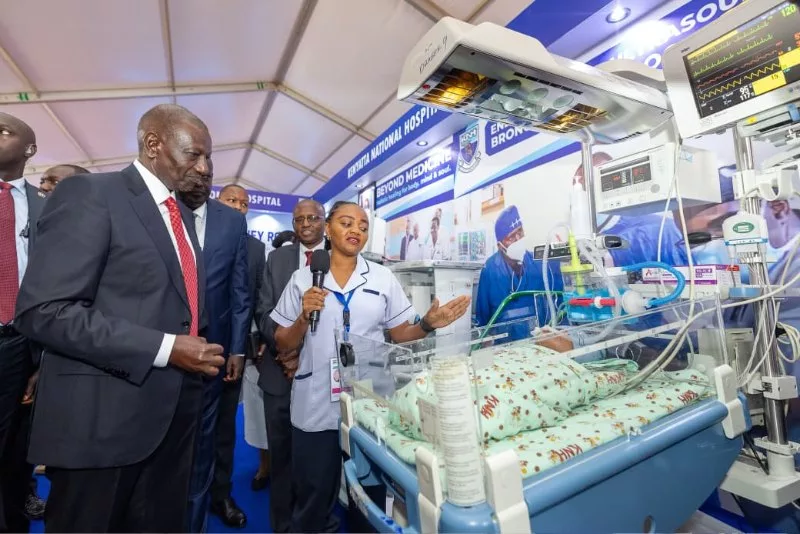
Ruto during Kenya Health Summit 2026 at KICC
President William Ruto has officially opened the inaugural Kenya Health Summit 2026 at the Kenyatta International Convention Centre (KICC) in Nairobi, bringing together thousands of health-sector stakeholders to assess Kenya’s reform journey and chart the next phase of Universal Health Coverage.
The two-day Kenya Health Summit 2026, running from August 18 to 19, is being held under the theme “Reform Delivered, Health as a Right.” The summit brings together national and county governments, healthcare professionals, development partners, innovators and other stakeholders to discuss the future of healthcare in Kenya.
The meeting comes at a crucial point in Kenya’s healthcare transformation, with the government seeking to move from policy commitments to measurable implementation in areas including the Social Health Authority (SHA), primary healthcare, digital health, medical supplies, healthcare financing and workforce development.
Ruto Opens Kenya Health Summit at KICC
President Ruto presided over the opening of the national health summit at KICC on Tuesday, August 18, 2026.
The summit is positioned as a national platform for reviewing the progress of health reforms while identifying priorities that can accelerate the country’s journey towards Universal Health Coverage.
According to the official Kenya Health Summit programme, the gathering is expected to bring together more than 5,000 delegates, over 50 speakers and participants from more than 40 countries.
The opening brought together senior government officials and other leaders involved in Kenya’s healthcare sector, including Deputy President Kithure Kindiki and Prime Cabinet Secretary Musalia Mudavadi.
The summit will run through Wednesday, August 19, with discussions focusing on how Kenya can strengthen healthcare delivery and ensure health becomes a practical right for citizens across all 47 counties.
Kenya Health Summit 2026 Theme: “Reform Delivered, Health as a Right”
The theme of this year’s summit is “Reform Delivered, Health as a Right.”
The theme reflects the government’s emphasis on translating healthcare reforms into tangible improvements for patients.
Rather than concentrating exclusively on policy announcements, the summit provides a platform to examine what has already been implemented, what has worked and where gaps remain.
The official summit website describes the event as a national forum intended to review Kenya’s health reform journey, celebrate achievements and accelerate Universal Health Coverage.
Key Health Issues Being Discussed at the Summit
Several major areas are at the centre of the Kenya Health Summit 2026.
Social Health Authority and Universal Health Coverage
The Social Health Authority (SHA) remains one of the most important components of Kenya’s healthcare reforms.
The government is seeking to establish a sustainable health-financing system capable of improving access to healthcare while reducing the financial burden on patients.
The summit provides an opportunity for stakeholders to examine the progress of SHA, identify challenges experienced during implementation and discuss ways of making healthcare financing more efficient and accessible.
Universal Health Coverage remains the broader objective, with the government seeking to ensure that Kenyans can access quality healthcare without suffering financial hardship.
Primary Healthcare and Community Health
Primary healthcare is another major pillar of the summit.
The government has increasingly focused on bringing healthcare services closer to households through community health programmes and Primary Care Networks.
Community-level healthcare can help Kenya shift towards prevention and early intervention rather than relying heavily on hospitals after illnesses become severe.
The summit is therefore expected to examine how primary healthcare can be strengthened and integrated into the wider UHC system.
Digital Health and Innovation
Digital transformation is also receiving significant attention at the Kenya Health Summit.
The official summit programme identifies digital health innovation as a key area, including technologies such as telemedicine, artificial intelligence and interoperable health systems.
Digital health has the potential to improve patient records, referrals, disease surveillance and access to healthcare information.
For Kenya, the challenge will be ensuring that digital systems are properly integrated and accessible across counties, including areas where infrastructure and connectivity remain limited.
KEMSA and Medical Supplies
The efficiency of the Kenya Medical Supplies Authority (KEMSA) is another major issue being examined.
Reliable availability of medicines and medical commodities is essential to the success of any health system.
Patients may have access to hospitals and healthcare workers, but treatment can still be disrupted when essential medicines or supplies are unavailable.
The summit therefore provides a platform for stakeholders to examine supply-chain efficiency and identify ways of improving the availability of essential health products in public facilities.
Healthcare Workforce
Healthcare workers remain central to Kenya’s health transformation agenda.
The country requires adequate numbers of doctors, nurses, clinical officers, specialists and other healthcare professionals to ensure reforms translate into better services.
The summit’s discussions on clinical excellence and workforce capacity are therefore expected to focus on strengthening the skills, distribution and working environment of healthcare professionals.
The official summit programme identifies strengthening workforce capacity and quality of care across all counties as one of its priorities.
Ruto’s Health Reforms Under Review
The summit provides the government with an opportunity to take stock of health reforms implemented during President Ruto’s administration.
The review covers the progress made under the government’s broader development agenda and the measures introduced to transform healthcare financing and service delivery.
The government is seeking to demonstrate how reforms have changed healthcare access while also identifying areas requiring further intervention.
The summit therefore comes at a time when policymakers, healthcare workers and members of the public are closely watching the implementation of health reforms.
Ruto Highlights NHIF Challenges
During the summit, President Ruto also highlighted problems that he said existed under the former National Health Insurance Fund (NHIF).
Ruto cited alleged fraudulent claims involving repeated medical procedures for the same patient as part of the problems that informed the government’s decision to reform the health insurance system.
The remarks underline the government’s argument for changing the previous health insurance framework and establishing SHA.
The transition has nevertheless placed strong emphasis on accountability, efficiency and ensuring that public health funds are used to provide actual healthcare services.
Kenya Health Summit Brings Together 5,000+ Delegates
The scale of the 2026 summit reflects the importance the government has placed on the country’s health transformation agenda.
According to the official Kenya Health Summit website, more than 5,000 delegates, 50-plus speakers and representatives from more than 40 countries are expected to participate.
The summit also features county showcases, an exhibition pavilion and spaces dedicated to health innovation and partnerships.
The exhibition programme includes demonstrations of health technologies and innovations, while themed networking areas focus on primary healthcare, digital health, financing and workforce development.
Health Summit Focuses on All 47 Counties
County governments have a central role in Kenya’s healthcare delivery system.
The summit therefore provides an opportunity to compare health innovations and experiences from across the country’s 47 counties.
The official programme includes county innovation showcases designed to highlight solutions and best practices being implemented at the local level.
This county-level focus is important because healthcare challenges vary considerably across Kenya.
While some counties may require greater investment in infrastructure and specialist services, others may need stronger primary healthcare networks, staffing, medical supplies or digital systems.
Musalia Mudavadi Calls for Resilient Health System
Prime Cabinet Secretary Musalia Mudavadi has called for a stronger and more resilient healthcare system capable of anticipating and responding to future health emergencies.
Mudavadi argued that Kenya should not continue relying primarily on responding after health emergencies occur, but should instead invest in systems capable of identifying threats early and maintaining essential services during crises.
His message adds another dimension to the summit’s discussions, particularly around health security, preparedness and resilience.
Moses Wetang’ula Links Health Reforms to Legislation
National Assembly Speaker Moses Wetang’ula also addressed the summit, stressing the importance of legislation in supporting health-sector reforms.
Wetang’ula linked Kenya’s modern health agenda to the country’s longstanding effort to fight poverty, ignorance and disease.
He argued that an effective legal framework is necessary for government policies and programmes to succeed, highlighting Parliament’s constitutional role in creating laws that support national development.
Presidential Town Hall to Give Kenyans a Voice
One of the anticipated highlights of the Kenya Health Summit is the Presidential Town Hall, which is expected to give Kenyans an opportunity to share their experiences and concerns about healthcare.
The forum will provide a public-facing component to the summit by allowing citizens to raise issues affecting them directly.
Questions around SHA, access to medicines, hospital services, healthcare costs, staffing and quality of treatment are likely to remain important topics for ordinary Kenyans.
The inclusion of public participation also reinforces the summit’s focus on treating healthcare as a right rather than simply a government programme.
Kenya Health Summit 2026 Key Facts
| Item | Details |
|---|---|
| Event | Kenya Health Summit 2026 |
| Dates | August 18–19, 2026 |
| Venue | Kenyatta International Convention Centre, Nairobi |
| Theme | Reform Delivered, Health as a Right |
| Host | Ministry of Health, Kenya |
| President opening summit | William Ruto |
| Main focus | Health reforms and Universal Health Coverage |
| Expected delegates | 5,000+ |
| Counties represented | 47 |
| International participation | 40+ countries |
| Major areas | SHA, UHC, primary healthcare, digital health, workforce, financing and medical supplies |
The official summit website confirms the August 18–19 dates, KICC venue and the summit’s focus on health policy, innovation and partnerships.
Kenya’s Health Reform Roadmap
The discussions at the summit can be viewed as part of a broader journey from healthcare challenges to Universal Health Coverage.
What the Kenya Health Summit Means for Kenyans
For millions of Kenyans, the success of the health summit will ultimately be determined by what happens beyond the conference rooms.
Patients want to know whether they can access healthcare when they need it, whether medicines are available, whether SHA will work efficiently and whether hospitals have enough qualified healthcare professionals.
The summit therefore presents an opportunity to connect national policy with the everyday experiences of patients.
The government’s challenge will be to turn the commitments made at KICC into measurable improvements in hospitals, health centres, dispensaries and communities across the country.
What Happens After the Kenya Health Summit?
The most important phase will begin after the summit concludes.
The official programme is designed to produce actionable outcomes, policy commitments, partnerships and implementation roadmaps that can guide the next stage of Kenya’s health transformation.
The focus will consequently shift from discussions to implementation.
National and county governments will need to coordinate closely, while healthcare workers, development partners, private-sector players and communities will have a role in ensuring that agreed reforms produce measurable results.
Kenya Health Summit 2026: The Road Ahead
President William Ruto’s opening of the Kenya Health Summit 2026 has placed Kenya’s healthcare transformation agenda at the centre of national attention.
The two-day meeting at KICC brings together national and county leaders, healthcare professionals, development partners, innovators and other stakeholders to review reforms and establish priorities for the future.
From SHA and Universal Health Coverage to primary healthcare, digital innovation, KEMSA, healthcare workers and health security, the summit covers many of the issues that directly affect healthcare delivery.
The theme “Reform Delivered, Health as a Right” sets a clear benchmark for the discussions: healthcare reforms must ultimately produce tangible benefits for Kenyans.
As the summit continues on August 18 and 19, attention will increasingly turn to the commitments and implementation plans that emerge from the meeting and whether they can accelerate Kenya’s journey towards quality, affordable and accessible healthcare for all.