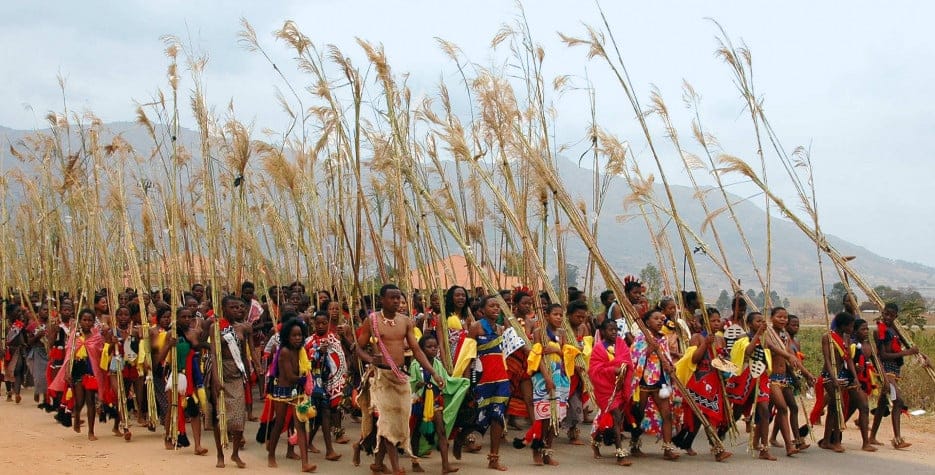
Thousands of young women have gathered at the Ludzidzini Royal Village in Eswatini for the 2026 Umhlanga Reed Dance, one of the country’s most significant traditional and cultural ceremonies.
The colourful annual event brings together unmarried and childless young women, traditionally known as Imbali, from different parts of the Kingdom of Eswatini.
The 2026 ceremony is taking place from August 25 to August 31, with the main celebrations culminating at Ludzidzini Royal Residence on Monday, August 31.
King Mswati III is expected to participate in the main ceremony alongside members of the royal family and thousands of spectators.
What is the Umhlanga Reed Dance?
The Umhlanga Reed Dance is an annual cultural ceremony in Eswatini in which young women gather to cut reeds and present them to the Queen Mother, known as the Indlovukazi.
The reeds are traditionally used to repair the reed enclosure surrounding the royal residence.
The ceremony combines communal work, traditional singing, dancing and cultural instruction and has become one of Eswatini’s most recognisable cultural events.
The young women wear traditional attire as they perform choreographed dances and songs before the Queen Mother, the King and other members of the royal family.
The event is also an important occasion for communities from different parts of Eswatini to come together and celebrate their shared cultural identity.
Why virginity is associated with the ceremony
Virginity and chastity have traditionally been associated with participation in the Umhlanga ceremony.
Within traditional Swazi culture, the Reed Dance has been used as an avenue for encouraging young women to uphold values such as discipline, self-respect, abstinence and responsibility.
However, describing the ceremony simply as a “virginity declaration” does not fully capture its cultural significance.
The event is a broader cultural practice involving communal service, traditional education, singing, dancing and the preservation of Swazi customs.
It is therefore more accurate to describe the participants as young unmarried women taking part in a traditional ceremony that has historically placed strong emphasis on chastity and moral values.
Does King Mswati III choose a wife at the Reed Dance?
The presence of King Mswati III has attracted international attention partly because of Eswatini’s traditional monarchy and the King’s polygamous marriages.
Historical accounts have linked the Reed Dance with the selection of brides for the King. However, choosing a wife is not the primary purpose of the Umhlanga ceremony.
The event is primarily a cultural and traditional gathering involving the presentation of reeds to the Queen Mother, communal activities and performances by the maidens.
It would therefore be misleading to suggest that thousands of young women attend the ceremony simply so that King Mswati III can choose a new wife.
King Mswati III currently has multiple wives, and reports of royal marriages have periodically drawn international attention to Eswatini’s traditional system of polygamous marriage.
Maidens travel from across Eswatini
The participants come from different communities and regions across the country.
Before the main celebration, the maidens take part in activities associated with the preparation and collection of reeds.
The reeds are subsequently transported to the royal residence, where they are presented to the Queen Mother.
The process creates a strong sense of community among the participants and allows younger generations to participate directly in traditions that have been passed down over generations.
A major celebration of Swazi culture
For Eswatini, the Umhlanga Reed Dance is more than a colourful public spectacle.
The ceremony is an important expression of Swazi cultural identity and provides an opportunity for traditional leaders, young people and communities to participate in a shared national tradition.
Traditional songs and dances form a central part of the celebrations, while the colourful attire worn by participants has made the event a major attraction for visitors and international audiences.
The ceremony also highlights the continued influence of traditional institutions within Eswatini, Africa’s last absolute monarchy.
King Mswati III’s role
King Mswati III plays a central symbolic role in the country’s traditional system of governance and culture.
His appearance at the main Umhlanga ceremony places the monarch alongside the Queen Mother and traditional leaders as the celebrations reach their climax.
The King has previously used the occasion to speak to young women about their responsibilities, conduct and participation in traditional society.
For supporters of the ceremony, such messages reinforce cultural values and encourage younger generations to maintain traditions.
Controversy surrounding the Reed Dance
Despite its cultural importance, the Umhlanga Reed Dance has also generated debate.
Supporters view it as an important celebration of Swazi identity, cultural preservation and traditional values.
Critics, however, have raised questions about issues including the expectations placed on young women, gender roles and the relationship between cultural traditions and modern social values.
These differing perspectives mean that the Reed Dance is both a celebration of cultural heritage and a subject of wider debate about the place of traditional practices in contemporary society.
Why the Eswatini Reed Dance attracts global attention
The scale of the ceremony, the traditional clothing, the large number of participants and the involvement of the royal family have made Umhlanga one of Africa’s most recognisable cultural festivals.
Images and videos from the ceremony regularly attract attention across social media, particularly during the final day when thousands of maidens gather at Ludzidzini.
For international audiences, the ceremony offers a glimpse into the traditions of the Kingdom of Eswatini, while for many Emaswati it remains an important annual expression of their cultural heritage.
As the 2026 Umhlanga Reed Dance reaches its climax on August 31, thousands of maidens will participate in traditional dances and ceremonies at Ludzidzini Royal Village, bringing another edition of one of Eswatini’s most important cultural traditions to a close.
The event continues to demonstrate how deeply traditional culture remains woven into the social and national identity of Eswatini.