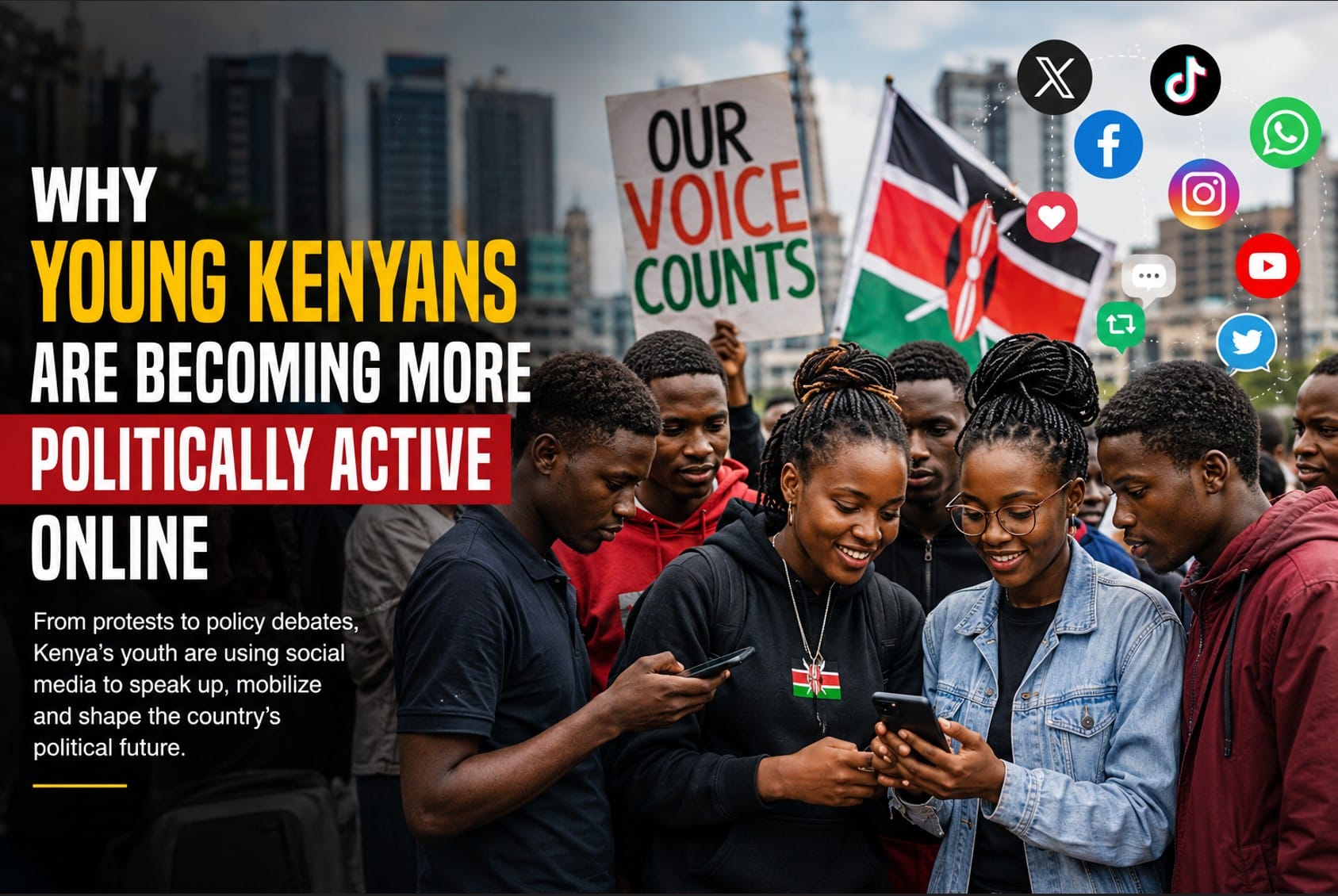
Kenya’s political conversation is increasingly moving from rallies, television studios and newspaper pages to smartphones, social media timelines and online communities, with young people emerging as some of the country’s most influential digital political voices.
From debates over taxes and the cost of living to discussions about unemployment, corruption and government accountability, young Kenyans are using platforms such as TikTok, X, Instagram and WhatsApp to question political decisions, share information and mobilise around issues affecting their lives.
The transformation became particularly visible during the 2024 anti-Finance Bill protests, when thousands of young Kenyans took to the streets after weeks of intense online mobilisation.
Two years later, the influence of digital activism remains significant as Kenya approaches the 2027 General Election.
Social media has changed how young Kenyans participate in politics
For many young Kenyans, political participation is no longer limited to attending rallies or joining political parties.
A smartphone can provide a direct platform for expressing an opinion, sharing information, challenging a politician or mobilising others around a public issue.
The 2024 protests provided one of the clearest examples of this changing political landscape.
According to Afrobarometer research published in February 2026, Kenyans who posted about politics or community affairs on social media were 1.9 times more likely to report participating in a protest than those who did not engage politically online. The study also found that young people, urban residents and men were significantly more likely to report protest participation.
The findings provide evidence of a strong relationship between digital political engagement and participation in street protests.
The Gen Z protests changed Kenya’s political conversation
The 2024 Finance Bill protests demonstrated the ability of young Kenyans to use social media to turn online conversations into physical mobilisation.
Young people circulated information about the proposed legislation, explained tax proposals, shared protest locations and encouraged others to participate through platforms including X, TikTok and Instagram.
Afrobarometer described the mobilisation as largely youth-driven and initially “tribeless”, “leaderless” and “partyless”. The movement later expanded beyond Gen Z under the broader “Gen-Zote” identity.
The protests eventually forced President William Ruto to withdraw the Finance Bill on June 27, 2024.
The events demonstrated that political influence could emerge from digital networks outside traditional political parties.
A young Kenyan did not need to be a party official, elected representative or prominent political activist to contribute to a national political conversation.
A smartphone and an internet connection could be enough to reach thousands of people.
Young Kenyans are highly connected to social media news
The growing political influence of social media is also connected to the way young people consume information.
Afrobarometer’s analysis of Kenya found that 57% of young Kenyans frequently received news from social media, meaning they accessed news through social platforms a few times a week or more.
This has important implications for political communication.
A politician’s speech can be clipped and shared within minutes. A proposed law can be explained through a short video. A parliamentary debate can become the subject of a viral discussion before traditional news bulletins are broadcast.
Political information is therefore increasingly becoming part of the everyday digital experience of young Kenyans.
The Reuters Institute’s 2025 Digital News Report also highlighted the growing influence of decentralised digital activism in Kenya, noting that the 2024 protests largely relied on platforms including X, TikTok and WhatsApp rather than traditional media structures.
Economic frustrations are pushing young people into political conversations
The increased political engagement among young Kenyans cannot be separated from economic concerns.
Employment opportunities, the cost of living, taxation and corruption remain major issues for the country’s younger population.
Afrobarometer found that Kenyan youth were particularly concerned about the management of the economy, corruption and unemployment. In its 2024 survey, 40% of young respondents identified management of the economy as one of the country’s most important problems, while 40% cited corruption and 36% cited unemployment.
Another Afrobarometer analysis published in May 2025 found that 43% of Kenyan youth surveyed said they were looking for work, compared with lower proportions among older age groups.
For young people facing unemployment or struggling with the rising cost of living, political decisions have a direct effect on their daily lives.
Taxes are not simply government policy.
They can determine how much a young worker takes home, how much a small business pays, how much consumers spend on goods and whether a young entrepreneur can remain in business.
That connection between politics and everyday economic survival is helping to drive online political conversations.
Young Kenyans are questioning traditional political parties
The growing popularity of issue-based online activism also comes at a time when traditional political party identification has weakened.
Afrobarometer reported in March 2025 that only 47% of Kenyans said they felt close to a political party, down from 68% in 2003. At the same time, 77% said many political parties were necessary to give voters real choices.
The figures suggest that support for multiparty democracy remains strong even as personal attachment to political parties declines.
For young voters, this may create room for issue-based political participation.
A person can oppose a tax proposal without becoming a member of an opposition party. They can support a government programme while criticising other policies. They can demand accountability from politicians across the political divide.
Social media makes this kind of independent political expression easier.
Political memes and short videos have become powerful tools
Kenyan youth have also developed their own digital language for discussing politics.
Political memes, short TikTok videos, satire, hashtags and viral clips have become common ways of commenting on public affairs.
A lengthy political speech can be reduced to a short video that reaches thousands of people.
A complicated policy can be turned into an infographic.
A politician’s statement can become a meme within minutes.
Although political humour is often dismissed as entertainment, it can also communicate criticism and shape public opinion.
For a generation accustomed to consuming information through short-form content, political communication increasingly has to compete for attention in the same digital environment as entertainment.
Online activism is beginning to move towards voter mobilisation
The next major test of Kenya’s digital political movement could come during the 2027 General Election.
Youth-led voter mobilisation campaigns are already using social media to encourage young Kenyans to register as voters.
The Star reported in March 2026 that young people were using social media to mobilise their peers ahead of the 2027 elections, including through the #TukoKadi campaign. The report said the IEBC was undertaking voter registration efforts targeting more than six million new voters ahead of the polls.
This represents an important development.
The question is no longer simply whether young Kenyans can use social media to protest.
It is whether they can use the same digital networks to influence voter registration, turnout and electoral choices.
If online activism translates into participation at the ballot box, the political influence of Kenya’s youth could become even more significant.
But online political activism has risks
The growing role of social media in Kenyan politics also presents serious challenges.
Digital platforms can spread accurate information quickly, but they can also amplify misinformation, manipulated content and political propaganda.
A viral post is not necessarily a factual post.
Young people can also be exposed to highly polarised political debates in which emotional reactions spread faster than verified information.
This creates a growing need for digital and media literacy.
Political participation is most effective when citizens can distinguish between facts, opinion, satire, propaganda and deliberately misleading information.
Politicians are also adapting
Kenya’s political class is increasingly aware that social media can influence public opinion, particularly among younger voters.
The traditional political rally remains important, but politicians can no longer ignore TikTok, X, Facebook, Instagram and WhatsApp.
A politician can now communicate directly with supporters without relying entirely on television stations or newspapers.
At the same time, politicians can be challenged directly by citizens online.
This has changed the relationship between political leaders and their audiences.
A public statement can immediately attract thousands of comments, criticism and fact-checking attempts.
That creates both an opportunity and a challenge for political leaders.
Young people are demanding accountability
At the heart of Kenya’s growing online political activism is a broader demand for accountability.
Young people are increasingly questioning how public money is spent, whether government policies are delivering results and whether elected leaders are responding to citizens’ concerns.
The 2024 protests demonstrated the potential strength of this sentiment.
A 2026 analysis by researchers from the Institute for Development Studies at the University of Nairobi and published by Brookings noted that young Kenyans have used popular social media platforms to organise, protest and resist socioeconomic policies they perceive as exclusionary.
The researchers also warned that while popular mobilisation can produce short-term political victories, sustaining its impact requires stronger institutional accountability and continued civic engagement.
That may prove to be the most important challenge facing Kenya’s youth movement.
Will online activism change the 2027 election?
Kenya’s 2027 General Election will provide an important measure of whether the country’s digital political awakening has developed into lasting political participation.
Young Kenyans have already demonstrated their ability to organise online and influence national conversations.
The next question is whether that energy will result in higher voter registration, greater turnout and stronger scrutiny of candidates and political parties.
If it does, Kenya could witness a significant shift in the way elections are fought and won.
Political campaigns will have to compete not only for crowds at rallies but also for attention on social media.
Candidates will have to communicate with a generation that can instantly question their promises, examine their records and mobilise others around political issues.
Kenya’s political future is increasingly digital
The rise of online political participation among young Kenyans does not mean traditional politics has disappeared.
Political parties, rallies, Parliament and elections remain central to the country’s democracy.
What has changed is the space in which political participation takes place.
For millions of young Kenyans, politics is now part of their digital lives.
They discuss government policies on WhatsApp, challenge politicians on X, watch political explainers on TikTok and use Instagram to communicate their views.
The 2024 Gen Z protests demonstrated that these online conversations can have consequences beyond the internet.
As Kenya moves toward the 2027 General Election, the influence of this digital generation is likely to become even more important.
Young Kenyans are not simply consuming political information anymore. They are creating it, challenging it, sharing it and using it to demand accountability.
The smartphone has become more than a communication device.
For Kenya’s younger generation, it is increasingly becoming a political tool.